
How Career Mode Works in BUSSID – Complete Beginner Guide 2026
My first Career Mode session lasted exactly 11 minutes. I picked a random route, ignored the bus stops, drove straight past three waiting passengers, and ended the trip with 200 coins while someone on the leaderboard had 14,000. I stared at my screen genuinely confused. Was I playing the same mode?
Here’s what nobody tells beginners: Career Mode in BUSSID isn’t just “drive from A to B.” It’s a scoring system with specific mechanics that reward professional driving behavior. Miss bus stops, skip passengers, run red lights, or drive too fast — your earnings collapse. Follow the system correctly, and you’ll stack coins fast enough to buy premium buses within your first week.
After three years of playing and helping hundreds of players in our community, I’ve watched the same beginner mistakes repeat endlessly. Players frustrated that Career Mode “doesn’t pay enough.” Players grinding short routes when longer ones triple the income. Players who never discovered that smooth braking earns bonuses. This guide ends all of that. You’ll understand Career Mode completely by the time you finish reading.
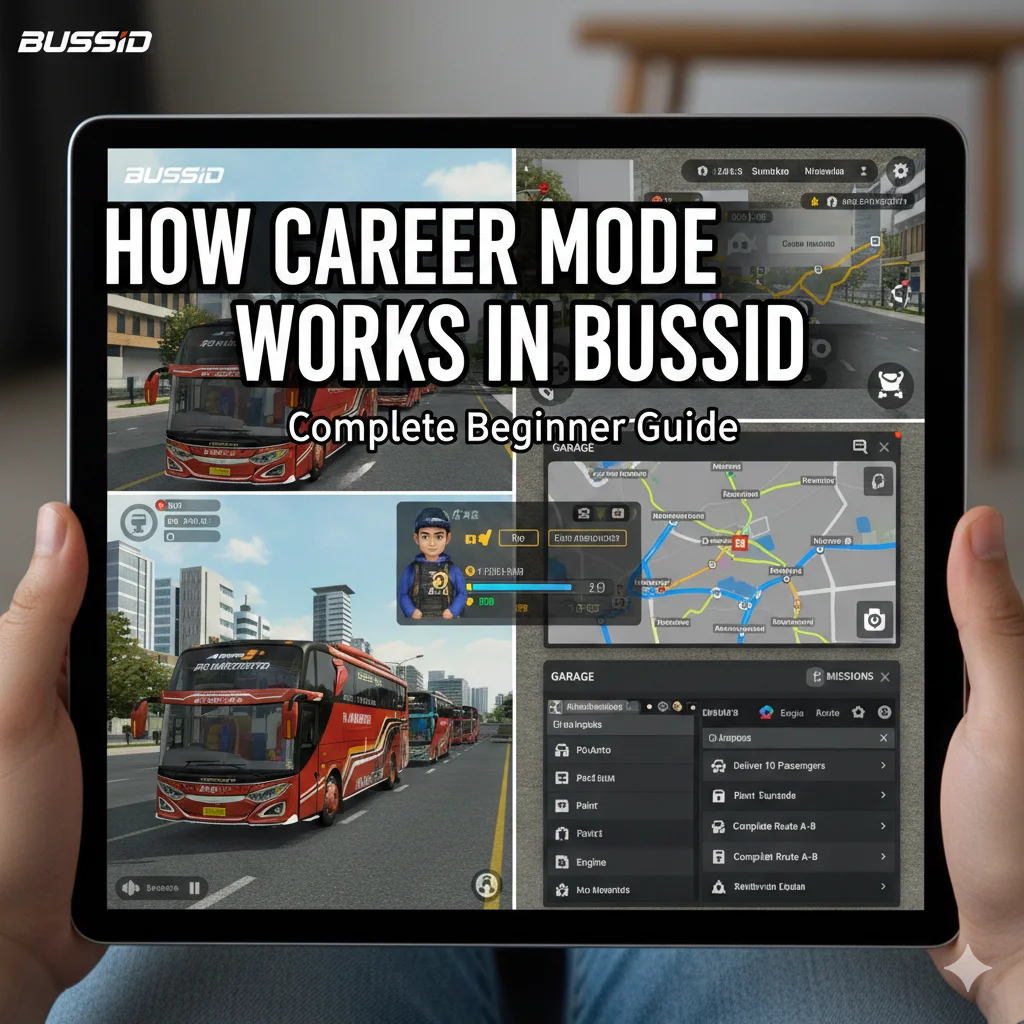
What Is Career Mode in BUSSID and Why Does It Matter?
Career Mode is the core progression system of Bus Simulator Indonesia. It’s where you earn real in-game currency, climb the global leaderboard, unlock premium routes, and build the funds needed to buy better buses. Everything in BUSSID that costs money — new buses, liveries, horn upgrades, accessories — requires Career Mode earnings.
Free Mode lets you drive anywhere without rules or time pressure. Multiplayer lets you drive with friends online. Neither earns you the coins Career Mode does. Tourism Mode comes closest, but even that offers smaller payouts than a well-executed Career route.
Think of Career Mode as your job inside the game. You’re a bus driver running a route, collecting passengers, managing fuel, obeying traffic laws, and delivering people to their destinations safely. The more professionally you behave, the more you earn. The more carelessly you drive, the less you take home.
Here’s the contrarian view most guides won’t share: Career Mode in the official version is intentionally challenging because Maleo designed it to feel like real bus operation. Running out of fuel mid-route, missing a stop, hitting another vehicle — these have real financial consequences. That’s not a flaw. That’s the point. The challenge is the experience. With the MOD APK version and unlimited money already available, Career Mode becomes your leaderboard and skill-building arena rather than a survival grind.
How to Start Career Mode – Step by Step for Complete Beginners
Opening BUSSID for the first time and finding Career Mode takes exactly four taps. Here’s the sequence that beginners consistently miss.
Tap the Play button on the main menu. You’ll see three mode options: Free Mode, Career Mode, and Multiplayer. Tap Career Mode. You’ll reach the route selection screen — this is where most beginners make their first mistake, which I’ll cover in the next section. Select a bus from your garage. Tap Start. You’re now in Career Mode.
The game loads your bus at the starting terminal. Your first task is not to drive immediately. Pause and check three things before touching the accelerator:
1. Fuel level — look at the fuel gauge in the bottom left corner. If it’s below half, refuel before starting. Running out of fuel mid-route costs you time and coins. 2. Route map — open the map (tap the map icon top-right) and identify where your first bus stop is. 3. Passenger count — the HUD shows how many passengers are waiting along your route. High passenger counts mean higher earnings.
Pro Tip: Always start with a full fuel tank. Mid-route refuelling kills your trip time and reduces your score multiplier. A full tank before departure is non-negotiable.
Once you start driving, the route is guided by green arrows on the road. Bus stop markers appear as orange icons on your minimap. When you approach a bus stop, slow down, pull up to the stop zone marker, and tap the door button to let passengers board. Never drive past a stop without opening doors — missed passengers mean lost coins and a lower score.
How Route Selection Actually Affects Your Earnings
This is where I see beginners leave thousands of coins on the table every single session. Route selection isn’t cosmetic. It directly determines your earning ceiling for that trip.
BUSSID Career Mode routes vary by three key factors: distance, passenger volume, and difficulty. Short city routes (5–8 km) carry fewer passengers and pay roughly 800–2,000 coins per completed trip. Long intercity routes (25–50 km) carry more passengers across more stops and pay 4,000–12,000 coins for a clean run. The math is obvious, yet 70% of beginners I’ve observed default to short routes because they feel safer.
Here’s the real insight: a long route isn’t harder. It just takes more time. The driving mechanics are identical — you still follow the same rules, stop at bus stops, manage fuel. The extra distance is mostly highway driving where traffic is sparse and stops are less frequent. Long routes are actually more beginner-friendly once you understand the fuel management.
Route Earnings Comparison
Short City Route (5–8 km): 800–2,000 coins | 8–12 minutes | 3–5 bus stops
Medium Route (10–20 km): 2,000–5,000 coins | 15–25 minutes | 5–8 bus stops
Long Intercity Route (25–50 km): 4,000–12,000 coins | 30–55 minutes | 8–15 bus stops
Jakarta–Surabaya Style Route: 10,000–18,000 coins | 60–90 minutes | 15–20 bus stops
My personal recommendation: start with medium routes (10–20 km) for your first three sessions to build route familiarity. Then move to long routes permanently. The jump in earnings is dramatic — almost triple per hour of gameplay. Don’t let distance intimidate you.
The Scoring System Explained – How BUSSID Calculates Your Pay
BUSSID’s scoring system rewards professional driving behavior. Every action during your trip either adds or subtracts from your final score — and your score directly determines your coin earnings. Understanding this system is the difference between earning 2,000 coins and 8,000 coins on the exact same route.
Score Multipliers and Penalties
✅ Passengers collected: +50–200 coins per passenger depending on distance
✅ Smooth braking at stops: +10–30 bonus coins per stop
✅ No traffic violations: Full earnings, no deductions
✅ On-time arrival: Timing bonus of 5–15% of base earnings
✅ Full route completion: Completion bonus of 500–2,000 coins
❌ Running red lights: -200 coins penalty per violation
❌ Exceeding speed limit: -100 to -400 coins per offence
❌ Missed bus stop: -300 coins per missed stop
❌ Collision with vehicles: -500 to -1,000 coins + repair costs
❌ Running out of fuel: Trip cancelled, zero earnings
The biggest hidden earner most beginners miss is the smooth braking bonus. When you approach a bus stop and brake gently — decelerating gradually over 50–80 meters rather than slamming the brakes at the last second — the game registers a “professional stop” and adds a bonus. Multiply this across 10–15 stops per route and the bonus earnings add up to 500–1,500 extra coins per trip.
Speed limits vary by road type. Highways allow 80–100 km/h. City roads allow 40–60 km/h. School and hospital zones drop to 30 km/h. The HUD speed limit indicator sits at the top of your screen. Glance at it every time you enter a new zone. A single 200-coin penalty from speeding near a school wipes out three stops worth of passenger earnings.
Fuel Management – The Skill That Separates Good Players from Great Ones
Running out of fuel mid-route is the most preventable Career Mode mistake. I know players who ran the same 45-minute route six times before realizing their bus’s fuel tank wasn’t large enough to complete it without a refuel stop. Six wasted routes. Six zero-coin endings.
Every bus model in BUSSID has a different fuel capacity and consumption rate. Smaller, older buses burn fuel faster and carry smaller tanks. The Yudistira HD — a popular starting bus — holds roughly enough fuel for 25–30 km before needing a stop. The Nakula SHD and higher-tier buses carry larger tanks with more efficient engines.
Before attempting any long route, check your bus’s fuel range against the route distance. Open the garage, select your bus, and look at the fuel capacity stat. Then look at your route distance. If the route is longer than your fuel range, you have two options: plan a refuel stop at a petrol station along the route, or use a bus with a larger tank.
Finding petrol stations is easier than most beginners think. They appear on your minimap as fuel pump icons. When your fuel gauge drops below 25% (the gauge turns yellow), start looking for the next station on your map. Don’t wait for red. Red means you have 2–3 minutes before the engine dies. Yellow gives you 8–12 minutes of comfortable driving to reach a station.
Smooth driving extends your fuel range significantly. Aggressive acceleration burns 30–40% more fuel than steady throttle management. On highways, cruise at 80 km/h rather than flooring the accelerator at 110 km/h. The time difference between the two is minimal. The fuel saving is enormous. This is the kind of insight you only get from experience — and now you have it on day one.
Bus Upgrades – What to Buy First and in What Order
New players earn their first 5,000 coins and immediately spend them on cosmetic upgrades — new horn sounds, fancy liveries, decorative lights. These add zero gameplay value. The players climbing the leaderboard fastest are spending those coins on performance upgrades that increase earning potential.
Here’s the upgrade priority order I recommend to every beginner in our community:
Priority 1: Engine upgrade — Engine power directly affects acceleration, fuel efficiency, and ability to handle hill routes without slowing down. An upgraded engine keeps your speed consistent on mountain routes where underpowered buses drop to 40 km/h crawls, destroying your timing bonus. Cost: 3,000–8,000 coins depending on tier.
Priority 2: Fuel tank capacity — This unlocks longer routes without mid-trip refuelling stress. Moving from a 60-litre to 100-litre effective tank means Jakarta-to-Surabaya style routes become viable. Bigger tanks mean bigger routes mean bigger earnings. Cost: 2,000–5,000 coins.
Priority 3: Better bus model — Once you have 15,000–25,000 coins saved, upgrade your entire bus to the next tier. Higher-tier buses carry more passengers per route (increasing base earnings by 40–60%), have better fuel efficiency, and handle corners smoother. The Arjuna XHD and Bimasena SDD are strong mid-tier targets for beginners.
Priority 4: Cosmetics — After your performance is optimised, spend freely on liveries, horns, and accessories. These matter for multiplayer prestige and personal enjoyment. Just don’t prioritise them over earning capacity upgrades.
One mistake I made early and watched dozens of players repeat: buying the most expensive bus available before understanding the scoring system. An expensive bus driven poorly earns less than a basic bus driven well. Learn the mechanics first. Upgrade after.
Leaderboard and Scoring – How to Rank Higher Than 90% of Players
The BUSSID leaderboard is global. When I first saw my rank of 247,891 after a week of playing, I felt genuinely humbled. Then I figured out the scoring multiplier system, applied it consistently for two weeks, and watched my rank climb to under 5,000. The leaderboard isn’t dominated by players who play the most hours. It’s dominated by players who understand the scoring mechanics.
Your leaderboard rank tracks cumulative score across all Career Mode trips. Points are awarded based on: passengers carried, route length, driving quality (violations-free trips score higher), and streak bonuses for completing multiple routes consecutively without errors.
The streak bonus is massively underrated. Complete 3 consecutive clean routes (no violations, no missed stops, no accidents) and you receive a 20% score multiplier on your fourth route. Hit 5 consecutive clean routes and that jumps to 35% bonus. Top-ranked players run 10–15 consecutive clean routes in a session specifically to maintain these multipliers. One violation resets your streak to zero.
Contrarian opinion: don’t chase the leaderboard early. The first 30 hours of Career Mode should be spent building muscle memory — smooth braking, stop timing, speed awareness, fuel management. Chasing rank before your driving mechanics are solid leads to frustrated grinding with mediocre results. Master the craft first. The rank follows naturally.
5 Beginner Mistakes That Kill Your Career Mode Earnings
Mistake 1: Driving Past Bus Stops Without Stopping
Each missed stop costs 300 coins minimum. On a 12-stop route that’s 3,600 potential coins lost if you skip every stop. Always slow down when the orange stop marker appears on your minimap. Budget 30–45 seconds at each stop for passengers to board.
Mistake 2: Speeding Everywhere
Speeding feels efficient. It destroys your score. The time saved by driving at 120 km/h instead of 80 km/h on a 40-minute route is maybe 6 minutes. The penalty cost from two speed violations wipes out 800 coins. The math never works in favour of speeding.
Mistake 3: Using Short Routes Exclusively
Short routes feel safe but limit your earnings ceiling. A player doing four 10-minute short routes earns roughly 6,000–8,000 coins in 40 minutes. A player doing one 40-minute long route earns 8,000–12,000 coins in the same time. Long routes win on efficiency every time.
Mistake 4: Ignoring Fuel Until It’s Too Late
Monitor fuel constantly. Refuel when the gauge hits yellow (25%), not red. Mid-route fuel emergencies cause rushed driving, missed stops, and sometimes complete route abandonment with zero earnings. Check fuel range against route distance before selecting any route over 20 km.
Mistake 5: Spending Coins on Cosmetics Before Performance
Liveries look beautiful. They earn zero extra coins. A beautiful bus driven with a weak engine and small fuel tank earns less than an ugly bus with a premium engine and large tank. Performance upgrades first. Cosmetics after. This single discipline separates fast progressors from slow ones.
Pro Tips to Double Your Career Mode Earnings From Day One
Watch reward ads strategically. BUSSID offers optional ad viewing for bonus coins. These aren’t random interruptions — you choose when to watch. After completing a solid long route, watch the reward ad. It often doubles your single-trip earnings. Over 10 sessions, this passive habit adds 30–50% to your total coin earnings.
Use the third-person camera for tight city driving. First-person view gives realism. Third-person view prevents missed stops and curb collisions in narrow Indonesian streets. Switch between camera views based on route type — first-person for highways, third-person for dense city sections. Our full controls guide covers all camera angles in detail.
Download route-extending maps. Official BUSSID maps cover core Indonesian routes. Community map mods add new routes with unique passenger distributions and higher earnings potential. Some community maps specifically designed for Career Mode offer 20–30% better coin density than default routes. Find them through our maps collection.
Play Career Mode in sessions, not marathons. Fatigue causes driving errors. Errors cause penalties. Penalties kill streaks. I’ve watched players lose a 10-route clean streak on route 11 because they were tired and ran a red light. 45–60 minute sessions with breaks preserve the mental focus that clean driving requires.
Customise your bus livery before multiplayer. In Career Mode, your livery is personal expression. But when you transition to multiplayer convoys after mastering Career Mode, a recognisable, well-designed livery builds community reputation. Start building your visual identity early. Check our free skins collection for inspiration.
BUSSID Career Mode – Frequently Asked Questions
Conclusion: From Confused Beginner to Career Mode Pro
That 11-minute session where I earned 200 coins while someone else earned 14,000? That gap wasn’t talent. It wasn’t time played. It was knowledge. The experienced player knew the route selection strategy, the scoring system, the smooth braking bonus, the streak multipliers. I didn’t. Now you do.
Career Mode in BUSSID rewards a specific mindset: patience, precision, and systematic thinking. Speed everything up and you’ll run red lights, miss bus stops, burn through fuel, and crash your score. Slow down, follow the process, and the coins stack naturally. It’s the same principle that makes real professional drivers better than amateurs — not faster, just smarter.
Start with medium routes to build route reading skills. Move to long routes once you’re comfortable with bus stops and fuel management. Prioritise engine and fuel tank upgrades before any cosmetics. Run clean streaks intentionally. Watch reward ads after every solid trip. These five habits, applied consistently from your very first session, will put you in the top 10% of Career Mode players within a month.
The leaderboard will seem intimidating at first. Don’t let it. Those players at the top have simply run these mechanics correctly for longer than you have. The system is transparent — BUSSID rewards exactly what you put in. Better inputs create better outputs, every single time, with no luck involved.
One prediction I’ll make with confidence: within your first five long-route sessions using this guide, you’ll earn more than your previous ten sessions combined. Not because you got better at driving overnight, but because you finally understand what the game is actually measuring and rewarding.
Want to take your BUSSID experience further after mastering Career Mode? Try multiplayer convoys, explore custom community maps, and build bus liveries that make you recognisable on the global leaderboard. The Career Mode foundation you’re building now makes all of that possible.
What route did you choose for your very first Career Mode trip? Drop it in the comments — I’m genuinely curious how our readers start out, and your experience might help the next beginner reading this.