
Best Routes in Bus Simulator Indonesia – Complete Route Guide 2026
Three months into playing BUSSID seriously, I thought I had routes figured out. I’d pick the longest one on the list, drive carefully, collect every passenger, and still come away underwhelmed by my earnings. Then one evening I watched a veteran player in our convoy group finish a route I’d never even noticed — medium length, specific city pair, busy corridor — and he walked away with nearly double what I earned on my marathon run. Same session time. Dramatically different result.
That moment pushed me to actually study how BUSSID’s route system works instead of just guessing. The best routes in this game aren’t simply the longest ones. They’re the ones that balance distance, passenger density, road type, and your current bus’s strengths. This guide breaks down every route category, names the standout city pairs, ranks them honestly, and explains exactly why each one earns what it does — so you can choose with information instead of instinct.
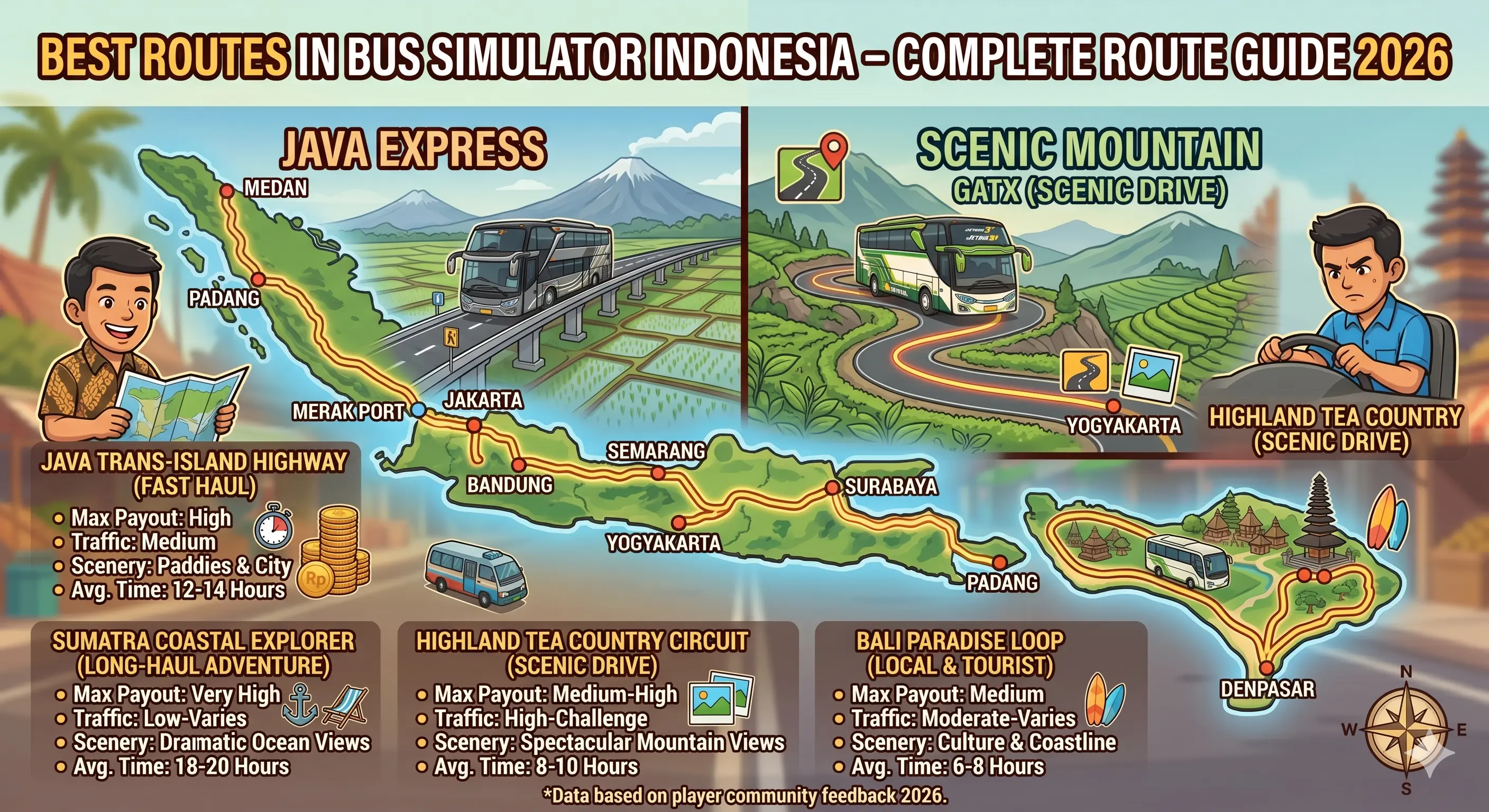
How BUSSID Routes Are Structured — What You Need to Know First
BUSSID routes operate on a simple but deep economy: you select an origin city, pick a destination, load passengers at bus stops along the corridor, and deliver them to complete the trip. The game then calculates your earnings based on how far you drove, how many passengers you collected, how cleanly you drove, and whether any penalties were applied. That final number — your payout — is what separates a good route choice from a great one.
Route types in BUSSID fall into four natural tiers. Understanding which tier you should be running at your current stage is the foundation of everything else in this guide.
| Route Tier | Distance | Best For | Avg. Earnings |
|---|---|---|---|
| City Short | 15–30 km | Beginners, starter buses | 800–2,500 coins |
| Regional Medium | 40–90 km | Mid-game, best coins/hour | 3,000–6,500 coins |
| Intercity Long | 100–200 km | Upgraded buses, big payouts | 6,000–13,000 coins |
| Cross-Province | 200 km+ | Max-level buses, endurance | 12,000–20,000 coins |
The Metric That Matters Most: Coins Per Hour — Not Coins Per Run
Here is the thing most players get wrong immediately: they judge a route by how many coins a single run pays. That’s not the right number to watch. What actually determines how fast you build your coin reserve is coins per hour — how much you earn across your entire session divided by the time you spent. A 90-minute cross-province run might pay 16,000 coins, but three 30-minute regional routes in the same window might pay 18,000 total. The regional player finishes ahead, and they got more driving practice in the process.
Best Short City Routes — Perfect for Beginners and Starter Buses
Short city routes in BUSSID are set within and around dense urban areas — the kind of driving where traffic is heavy, bus stops are close together, and the pace is quick. They’re not the highest earners per run, but they have real advantages that beginner guides completely underestimate. You build driving habit fast on short routes because the frequency of stops, junctions, and traffic checks means you’re practising the skills that matter — smooth braking, accurate stop positioning, speed awareness — on a tight loop rather than a long highway where you can coast.
Jakarta City Corridor
The Jakarta-based city routes are the closest thing BUSSID has to a training ground. Dense traffic, frequent stops, and the authentic chaos of Indonesia’s capital city make this one of the most immersive short routes in the game. Expect 10 to 16 bus stops on a single run and passenger counts in the high teens. It pays 1,200 to 2,500 coins for a clean run — not enormous, but very chainable. Three clean Jakarta city runs in 35 minutes gives you a solid hourly rate for a starter bus. The Jakarta traffic jam simulation is also genuinely challenging, which means your driving score bonuses become meaningful fast if you stay patient and disciplined through the congestion.
Bandung Urban Loop
Bandung’s city routes are popular with new players because the road layouts are slightly more forgiving than Jakarta — fewer extreme traffic pileups — while still giving you plenty of stops and consistent passenger density. The Bandung urban loop sits at roughly 20 to 28 km depending on the route variant selected, pays 1,400 to 2,800 coins on a clean run, and the terrain mixes flat city streets with occasional gentle inclines that introduce you to the fuel management habits you’ll need on longer routes later. Bandung is the route I’d recommend first to anyone who just downloaded the game and wants to learn without immediately getting overwhelmed.
💡 Short Route Pro Tip
On short city routes, the double earnings ad at trip end is proportionally more impactful than on long routes. A 2,000-coin short run becomes 4,000 coins in 30 seconds. Chain four of those and you’ve just earned 16,000 coins in under two hours with a starter bus. Never skip the doubler on short routes — the time-to-reward ratio is excellent.
Best Medium Regional Routes — The Sweet Spot for Most Players
If short routes are for learning and long routes are for endurance, medium regional routes are where most of your actual coin growth happens. This is the tier where coins-per-hour peaks for the majority of BUSSID players across most of the game’s progression. The 40 to 90 km corridor gives your bus enough distance to earn meaningful base pay while keeping run times short enough to chain multiple trips in a single session.
I ran the numbers across a full week of medium regional routes versus the same time spent on long intercity runs. The medium regional week produced 14 percent more total coins even though individual runs paid less. That gap widens further once you factor in the double earnings multiplier — you’re applying it more frequently per hour on medium routes than on marathon runs.
Yogyakarta to Solo (Surakarta)
This is arguably the most beloved medium route in BUSSID’s default map and for very good reason. The Yogyakarta–Solo corridor runs approximately 65 km through Central Java, passing through flat to gently rolling terrain that your bus handles cleanly without burning excess fuel. The route has excellent passenger density — consistently 14 to 20 passengers available depending on time of play — and the road quality means you can maintain smooth, penalty-free driving without needing to fight constant obstacles. Clean run earnings sit between 4,500 and 6,500 coins. Factor in the double earnings ad and you’re looking at up to 13,000 coins for 25 minutes of focused, careful driving. This is the route I default to when I want maximum efficiency without the time commitment of a long intercity run.
Semarang to Magelang
The Semarang–Magelang route is the hidden gem that experienced players don’t usually share in beginner communities. It runs roughly 70 km through Central Java and introduces moderate elevation changes — not mountain-level difficulty, but enough slope variety that smooth gear management starts earning you fuel savings and score bonuses that flat routes don’t offer. Passenger counts are solid at 12 to 18 per run. The terrain challenge makes this a great stepping stone between beginner flat routes and the demanding mountain corridors further up the map. Earnings on a clean run: 4,000 to 6,000 coins, with the full double pushing you past 12,000 for a single trip.
Malang to Batu
Malang to Batu is short-medium at around 18 km but earns disproportionately well because Batu is a hill station destination with a high passenger pull. The elevation gain on this route is significant — it winds up into the highlands above Malang — which makes it a fuel efficiency challenge and a test of your braking discipline on the return descent. Players who master this route early develop mountain driving instincts that serve them well on the hardest long-distance routes later. Earnings for a clean run: 2,800 to 4,500 coins. Small in isolation, but very chainable and genuinely educational.
Best Long Intercity Routes — High Payout, High Commitment
Long intercity routes are where BUSSID starts feeling like a proper driving simulation rather than a casual game. These 100 to 200 km corridors test everything — your bus’s engine stamina, your fuel management discipline, your patience through traffic variations, and your driving score consistency over an extended run. The payouts reflect that challenge. A clean long intercity run with the double earnings ad applied can deliver 15,000 to 24,000 coins for a single trip. That’s outstanding per-run value, but the 35 to 55 minute time commitment means you need to evaluate whether the coins-per-hour math works for your session plan.
Surabaya to Malang
Surabaya to Malang is the most consistently recommended long route in the BUSSID community, and the reputation is earned. The 90 km corridor from East Java’s biggest city to the mountain city of Malang blends flat urban highway driving in the Surabaya section with increasingly hilly terrain as you climb toward Malang. Passenger counts are among the highest of any route in the game — 18 to 24 passengers on a good run — because both endpoints are major population centres with genuine transit demand. The road quality is excellent for most of the corridor, meaning your penalty risk is low if you maintain speed discipline. A clean run here pays 7,000 to 11,000 coins. With the double earnings ad applied: 14,000 to 22,000 coins per single run. This is the route I recommend as the first long-distance target for anyone who has upgraded their engine and fuel tank to at least mid-tier.
Jakarta to Bandung
Jakarta to Bandung is the most famous real-world bus route in Indonesia — the Cipularang toll highway corridor that tens of millions of Indonesians travel annually — and BUSSID’s version captures much of that atmosphere. The route runs approximately 150 km, mixing heavy urban traffic out of Jakarta with the toll highway section, then the mountain approach into Bandung through the Puncak area. The scenery shift from dense city to highland greenery is one of the most visually varied in the entire game. It demands a well-upgraded bus because the elevation gain toward Bandung will punish an underpowered engine with excessive fuel consumption. Earnings on a clean run: 9,000 to 13,000 coins. Doubled: up to 26,000 coins per trip.
⚠️ Jakarta–Bandung Warning
Do not attempt Jakarta–Bandung with a starter or underpowered bus. The mountain section into Bandung is steep enough that a weak engine will burn through fuel at a punishing rate, forcing multiple refuelling stops that eat into your earnings and run time. Have at least engine level 3 and a mid-tier fuel tank before you take this route seriously.
Semarang to Surabaya
The Semarang–Surabaya north coast corridor is a long intercity route that rewards consistency over drama. At roughly 175 km along the Pantura (North Coast Road) — the most famous highway in Java — this route is mostly flat, toll-heavy, and high-speed. That combination means your biggest challenges are speed discipline on monitored sections and fuel management over the extended highway stretch. Penalty risk is high if you get complacent. But if you stay within limits, the flat terrain gives your bus the best possible fuel economy, which translates to fewer stops and cleaner earnings. A disciplined Semarang–Surabaya run pays 10,000 to 14,000 coins. With the double: up to 28,000 coins, making it one of the top single-run earners in the game for prepared players.
Best Cross-Province Marathon Routes — For Advanced Players Only
Cross-province routes are BUSSID’s endgame content. These 200 km-plus corridors are long enough to feel like genuine long-haul driving commitments, and the game expects your setup to reflect that. An underpowered bus on a cross-province run isn’t just slow — it actively loses you money through excess fuel stops, increased breakdown risk, and the simple reality that a route this long magnifies every poor driving decision into a larger coin deduction.
These routes are genuinely impressive from a game design standpoint. The Trans-Sumatra Highway route, for example, passes through jungle terrain, long elevated highway sections, and small-town stops that give you a sense of actually crossing a massive island. The Papua Jungle Track introduces unpredictable road conditions and steep gradients that no other route in the game replicates. The Sulawesi Coastal Road features narrow winding paths with sea views that demand completely different driving discipline than the Java highway network.
Jakarta to Surabaya — The Grand Champion
If there’s one route that defines BUSSID’s identity, it’s Jakarta to Surabaya. This is Indonesia’s most iconic intercity bus journey in real life — the overnight AKAP express that legendary operators like Rosalia Indah, Kramat Djati, and Pahala Kencana have been running for decades. In-game, it spans roughly 800 km of Java from the capital to East Java’s metropolis, and it passes through most of the island’s major transit cities: Cirebon, Tegal, Semarang, Demak, Kudus, Ngawi, Madiun, before the final approach into Surabaya. Clean earnings on a full run: 15,000 to 20,000 coins. With the double earnings ad: up to 40,000 coins for a single run. This is the pinnacle of BUSSID route earnings, but it demands a fully upgraded bus, strong fuel management, and the patience to commit to a 90-minute session without rushing and accumulating violations.
Trans-Sumatra Highway
The Trans-Sumatra route is a different challenge entirely. Where Java’s routes are dense with cities and traffic, Sumatra’s highway is long, forested, and characterised by stretches where you go miles between settlements. Fuel management becomes critical because the spacing between stations is genuinely wide. The route rewards careful planning — know where your next fuel stop is before you need it, and never let your tank drop below 30 percent on the remote sections. The payouts for a clean Sumatra long-haul are comparable to Java’s top routes, but the difficulty ceiling is higher. This is the route for experienced players who want to push themselves after mastering the Java network.
Scenic Routes Worth Driving — Not Everything Is About the Money
Here is an opinion that divides the BUSSID community: some of the best routes in the game are not the highest earners. The Sulawesi Coastal Road is genuinely one of the most beautiful driving experiences available on mobile — narrow coastal paths, sea to one side, jungle to the other, the bus barely fitting the width of some sections. You will not maximise your coins-per-hour on this route. You might also reverse off a coastal edge if you’re not careful. But as an experience, it’s worth doing repeatedly just to appreciate what Maleo built.
The Bali-inspired tourism routes deserve a mention here too. They’re built around scenic sightseeing rather than pure transit efficiency — pre-defined paths through landmark areas with a gentler pace and more forgiving traffic. New players who want to experience the game’s cultural atmosphere without the pressure of penalty management should try a tourism route in their first week. It teaches you the basics of BUSSID’s road environment without the anxiety of a competitive run, and you come away with a genuine appreciation for the detail Maleo put into the Indonesian environment.
Custom Map Routes — The Community Extends Everything
Since BUSSID version 3.7, the game has supported custom map mods, and the community has created an extraordinary range of routes beyond the default Java and Sumatra maps. Tawangmangu map mods recreate the famous mountain road in Central Java — a technical driving challenge that serious players treat almost like a benchmark test for their bus’s handling. Kalimantan map mods expand the game into Borneo’s river delta roads and jungle highways. Indian bus mods bring Kerala and Tamil Nadu routes into the game, complete with regional bus designs and horn sounds. These custom maps are installed via the in-game mod system and most require no external tools beyond a file manager app on Android.
Matching Routes to Your Bus — Why This Changes Everything
The route you choose and the bus you’re driving are inseparable decisions. Running the wrong bus on the right route is nearly as bad as picking the wrong route entirely. Here is the honest breakdown of how bus type should guide your route selection at each stage of the game:
Starter Bus (Yudistira HD, Nakula SHD)
Stay on city short and easy medium routes. Maximum 60 km per run. These buses have limited fuel tanks and modest engines — they can handle Bandung loops and short Jakarta corridors well, but anything longer starts burning fuel faster than the route pay justifies. Focus on building driving skill and coin reserves before moving up.
Mid-Tier Bus (Sadewa SHD, Arjuna XHD — partially upgraded)
Medium regional routes are your home. Yogyakarta–Solo, Semarang–Magelang, and similar 50 to 80 km corridors. You have the fuel capacity and engine output to complete these cleanly and chain multiple runs per session. This is the stage where coins accumulate fastest relative to time invested.
Advanced Bus (Bimasena SDD, Srikandi SHD — upgraded)
Long intercity routes open up fully. Surabaya–Malang, Jakarta–Bandung, Semarang–Surabaya. The Pantura and Cipularang corridors reward your investment. Your engine handles elevations cleanly and your fuel tank reaches end-of-route without emergency stops.
Max-Level Bus (fully upgraded premium models)
Cross-province marathons and custom extreme routes. Jakarta–Surabaya, Trans-Sumatra, Papua Jungle Track. Your bus is now genuinely capable of endurance runs. The per-trip earnings at this stage can exceed 35,000 to 40,000 coins with the double ad, making each session feel dramatically different from where you started.
Route Strategy for Multiplayer Convoy Mode
Route selection changes meaningfully when you’re in multiplayer convoy mode. In convoy play, the host sets the route and all participants drive together, which means your individual earnings depend partly on your driving quality and partly on how well the chosen route suits the group’s bus capabilities. Joining a convoy where the host picks a cross-province marathon while half the players have starter buses is a recipe for breakdowns, stragglers, and a frustrating session for everyone.
The community-preferred sweet spot for convoy routes is medium regional — roughly 50 to 80 km — because it accommodates the widest range of bus tiers without leaving anyone behind. If you’re hosting, pick Yogyakarta–Solo or a similar well-paved medium corridor and your convoy will finish together, everyone earns well, and the experience is genuinely enjoyable rather than a stressful chase across 200 km of highway.
Frequently Asked Questions
Q1. What is the single best route in BUSSID for earning coins?
For pure coins per run, Jakarta–Surabaya is the top earner — up to 40,000 coins per trip with the double ad. But for coins per hour across a session, Yogyakarta–Solo (medium regional) delivers better results for most players because it’s fast, chainable, and consistent. Match your answer to whether you want maximum per-run earnings or maximum session earnings.
Q2. Which route is best for beginners in BUSSID?
Bandung urban loop or Jakarta city corridor routes are best for beginners. They’re short, have frequent bus stops to practise positioning, and the time commitment is low enough that mistakes don’t cost you 45 minutes of a ruined run. Build your driving habits here first before moving to medium or long routes.
Q3. Are longer routes always more profitable in BUSSID?
No. Longer routes pay more per run but take more time. The key metric is coins per hour. Medium routes (40–90 km) are more efficient per hour for most players because you chain more runs, apply the double earnings ad more frequently, and accumulate total coins faster than a single long commitment delivers. Long routes become more efficient only when your bus is fast enough to shorten the time gap significantly.
Q4. What makes Surabaya–Malang the most recommended long route?
Surabaya–Malang combines the highest passenger density of any long route, excellent road quality that keeps penalty risk low, and a manageable 90 km distance that most mid-tier buses handle without fuel stress. It’s the ideal first long route because the difficulty curve is fair — challenging enough to be rewarding, manageable enough that you’re not constantly fighting your bus’s limitations.
Q5. How do custom map mods change available routes in BUSSID?
Custom map mods — supported since BUSSID v3.7 — add entirely new route networks beyond the default Java and Sumatra maps. Community mods cover Kalimantan, Sulawesi, Papua, and even international locations like Kerala India and Nepal. They install via the in-game mod system and expand the available route variety significantly. Popular options include Tawangmangu mountain mods, extreme offroad mods, and detailed city mods for Bandung and Malang.
Q6. Which bus is best for mountain routes like Malang to Batu?
For mountain routes, a bus with upgraded suspension, decent engine torque, and good tyre rating performs best. The Arjuna XHD and Sadewa SHD both handle moderate mountain terrain well once their engine and suspension are upgraded to at least level 2. Avoid taking an unupgraded starter bus onto steep mountain routes — the fuel drain and handling limitations make the run painful rather than profitable.
Q7. What is the Pantura route in BUSSID?
Pantura stands for Pantai Utara — the North Coast Road of Java. In real life and in BUSSID, it’s the main highway connecting cities across Java’s northern coast from Jakarta through Cirebon, Tegal, Semarang, and east toward Surabaya. It’s famous for being flat, fast, and toll-heavy. In BUSSID, the Pantura sections reward speed discipline and fuel efficiency because the flat terrain is where violations and fuel waste show up most clearly against a straightforward baseline.
Q8. Should I always pick the route with the most passengers?
Passenger count is important but not the only factor. A route with 22 passengers across 200 km of difficult mountain terrain may earn less than a route with 16 passengers on 70 km of clean flat highway — because penalties, fuel costs, and time investment all factor into your net earnings. Always weigh passenger count against distance, terrain difficulty, and how well your current bus handles the route type.
Q9. What routes work best in BUSSID multiplayer convoy mode?
Medium regional routes (50–80 km) work best for convoys because they accommodate the widest range of bus tiers. Cross-province marathons cause problems when convoy members have different bus capabilities. For competitive passenger chase modes in multiplayer, medium routes with high bus stop density give everyone fair competition opportunities rather than favouring the player with the fastest bus exclusively.
Q10. How do toll roads affect earnings on BUSSID routes?
Toll roads appear on several major routes — Jakarta–Bandung via Cipularang, Semarang–Surabaya via the toll section, and parts of the Jakarta network. Each toll plaza deducts coins from your earnings unless you watch the free ad to cover the cost. On long routes with multiple toll stops, always use the free ad. Paying coins at three or four toll plazas on a single long run can cost 600 to 1,200 coins that the free ad would have covered completely.
Your Route, Your Game — Choose With Information
Remember the veteran player I mentioned at the start — the one earning double my coins from a route I’d never noticed? He wasn’t running the longest route on the list. He was running the right route for his bus, at the right time, with the right habits applied. That’s the insight this whole guide is built around.
BUSSID’s route system is more sophisticated than it looks on the selection screen. The Yogyakarta–Solo medium corridor isn’t just a route — it’s a precision tool for mid-game coin accumulation. The Jakarta–Surabaya marathon isn’t just a long drive — it’s a test of everything your bus and your driving discipline can deliver. Even the Jakarta city loop isn’t just a starter grind — it’s a skills laboratory that makes you measurably better at every other route you’ll ever drive.
Start where your bus is today. Build the driving habits that clean runs reward. Upgrade before you overreach. And when Jakarta–Surabaya finally opens up properly for you — full bus, clean run, 40,000 coins with the doubler — you’ll know exactly how you got there.
Which route surprised you the most in BUSSID — the one you expected to be good, or the one you discovered by accident? Drop it in the comments. The community always finds routes the guides miss.